
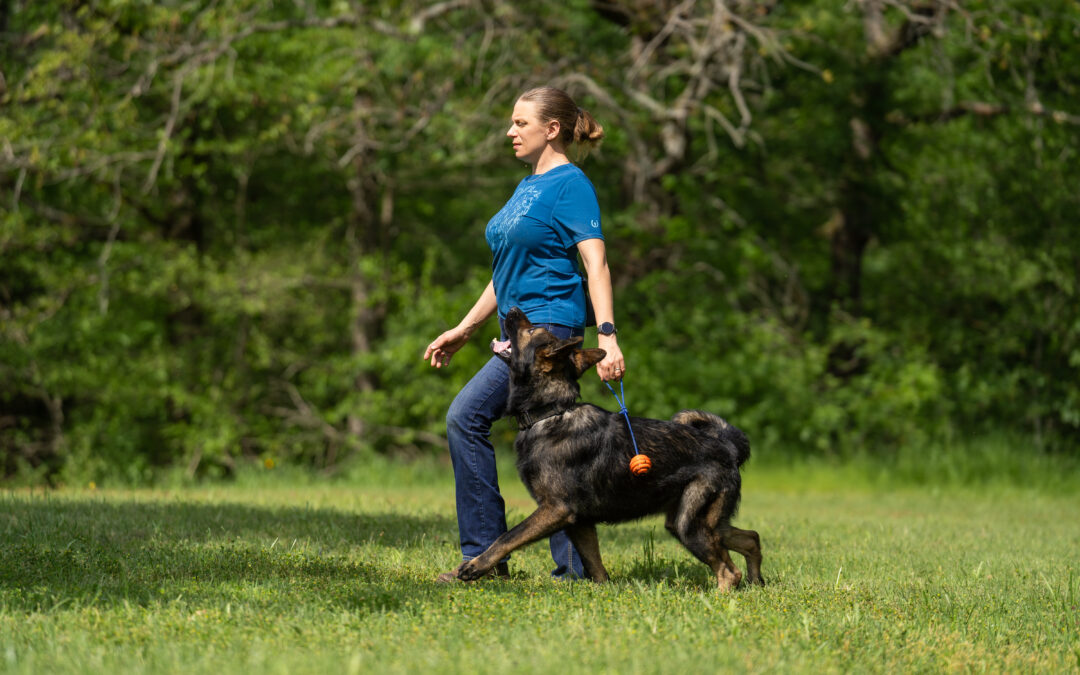
We ask a lot of our sport and working dogs. Sprint down the field. Launch at the decoy. Bite and counter. Go over the 1-meter jump, grab the dumbbell and return to front. Climb the palisade. Track over long distances. Hold precise positions. Navigate obstacles. Work under environmental and psychological pressure. Repeat that, week after week, for years.
These are athletic demands. Not training demands. Athletic demands.
A competitive horse has a conditioning program, a bodyworker, a nutrition plan, periodized training, and structured rest built into their season. Some competitive dogs have handlers who invest in modalities such as laser therapy, PEMF, massage, chiropractic, and acupuncture, in addition to training. Some working dogs have handlers who drill obedience patterns and hope the body underneath the behavior keeps up.
I’ve worked with both horses and dogs, and over the years, I’ve noticed that we train dogs to perform athletic tasks while largely skipping the development of the athlete responsible for performing them. In fact, I’ve been guilty of this myself.
Not because we as handlers don't care. Because the sport dog world was mostly built around training, not conditioning, and the two get treated as the same project when they're not.
Skill Training Is Not Athletic Development
Here's the distinction the sport dog world generally doesn't make: practicing the sport and developing capacity for the sport are not the same activity.
A PSA dog doing more bitework isn't automatically conditioning. More obedience patterns isn’t either. Repetition can sharpen a skill and load a structure at the same time, in the same session, without either the handler or the dog noticing which is happening. A dog repeating the same engagement pattern gets faster and more precise. He's also loading the same joints, at the same angles, at the same intensity, rep after rep, with no one asking whether that pattern is one his body should be repeating that often.
Skill and strain can accumulate on the same timeline, and often, dogs and handlers don’t realize what’s happening.
The same holds outside of bitework. A dog drilling repetitive fronts and finishes in obedience is sharpening precision, and building the exact same rotational load through his spine and hocks, pattern after pattern. In heeling, the dog holds its head and neck at an unnatural angle, always turned up and to the right. Sending the dog over a jump to retrieve a dumbbell causes them to translate enormous amounts of force through their entire body – from the tips of their hind toes all the way out through the front of their muzzle.
None of this means “stop training.” It means the reps are doing two jobs at once, and only one of them is usually getting tracked.
Fitness itself isn't one quality you either have or don't. Strength, power, endurance, mobility, coordination, and proprioception are distinct physical capacities. Each one requires a different kind of input to develop, and just because you train your dog to be strong doesn’t mean they’re mobile, coordinated, or aware of where their body is in space. Think of the bodybuilder who can’t touch his toes. Strong? Absolutely. Mobile? Not so much.
Why does the sport dog world default to "more training" as the answer to almost everything? A few reasons, and none of them are about handlers not caring.
Dog sport culture rewards behavior output. A powerful hit on the decoy. A solid out. A high obedience score. These are all impressive, but many times, dogs are asked to perform even when their bodies aren’t ready to absorb the forces we ask of them.
In the equine world, we evaluate the horse’s conformation and gaits for workability before asking them for work. The dog world does this to a point (especially breeders), but more often than not, there’s no cultural expectation that asks, “is this dog’s body able to meet the demands of what we’re asking of them?”
Most handlers also entered the sport through training, and learned skills such as drive building, bite development, handling, and obedience training. The concepts of conditioning and biomechanics are still largely unknown among most trainers, so they're generally not what trainers think about when the dog’s performance declines. When a dog starts refusing a jump, comes in low and slow on the bite, or loses focus mid-obedience routine, the first instinct is almost always to add more training – not to ask if the dog can actually perform the task that we’re asking of them.
Underneath both of those sits one assumption that does most of the damage: if the dog can perform the behavior, the dog is ready to perform the behavior. However, with high-drive dogs, this can become a trap. In the equine world, no trainer assumes that “just because the horse can gallop an eighth of a mile, they’re ready for the Kentucky Derby.” Dog sports often don’t ask whether the dog is ready to perform the behavior.
We train dogs to perform. We rarely condition the dog's body for what we're asking of them.
Everything below builds on that.
The Athlete As A System
Skill training is important, but it's not the same as athletic development. All of the individual pieces below make up a complete athletic system, whether equine, canine, or human.
Movement and biomechanics. How does this individual dog organize his body? Can he produce, transfer, and absorb force efficiently? Does he move symmetrically, or does he compensate in a pattern? Is he moving on his forehand, or driving from his hind end? Is he moving his legs efficiently? Structure predicts movement, and movement predicts where load accumulates over time. This is true of every athlete, whether they have two or four legs.
Conditioning. Does the dog's physical capacity match what the sport is asking of him? Strength, power, endurance, mobility, coordination, and proprioception are distinct adaptations, and each requires its own progressive loading. Repeated sends on the decoy might build the dog’s strength and power, but may not build his endurance, mobility, or coordination. Remember our bodybuilder example? A dog can have excellent strength and poor mobility, or plenty of power and almost no rotational stability, and more likely than not, neither the trainer nor the decoy will be able to tell you what’s off. I can.
Nutrition. Are we fueling the athlete we actually have, for the work he's actually doing? Not merely "is he eating good food?" Is he getting the right balance of protein, fat, carbs, vitamins, and minerals? Does his total caloric intake match his output, his recovery needs, and his individual load right now, this season, at this level of work?
Recovery. Training creates stress, and the dog needs time to recover from that stress. Sleep, workload management, nutrition, built-in lower-load days, and body care all live here, and it’s easy to cut some or all of these when the pressure cranks up and the trial date draws near. A dog who trains hard and recovers poorly isn't building capacity. He's accumulating fatigue that eventually shows up as a plateau, or worse, an injury.
Nervous system and arousal. A dog's physiological state changes his movement, learning, perception, and physical output in real time. Arousal isn't separate from performance – it’s part of what produces it. A dog in a high-arousal state is organizing his body differently, perceiving his environment differently, and making different choices than the same dog in a regulated state. Regulation is one of the variables that determine what the dog can access, physically and cognitively, at any given moment.
Behavior and learning. This is possibly the domain most handlers are already deeply invested in. However, behavior is produced by a living physical organism, not a disembodied training machine. When the body changes, behavior changes. When arousal changes, behavior changes. When pain, fatigue, or insufficient recovery are present, behavior changes. Training methodology matters, but it doesn't operate in a vacuum.
The handler. Our mechanics, reinforcement placement, leash handling, training choices, equipment, workload decisions, and your expectations all shape what happens to the athlete on the other end of the leash. I’ll also let you in on a little secret: our nervous system state is part of that equation. Our regulation is part of his system, whether either of us notices it happening or not.
No single input gives you the dog. The relationships between them do.
Training is the entry point. It’s the reason most of us are in the sport in the first place, and it's also the context in which all of these other inputs express themselves. The other domains support training, but they don’t replace it. They make it sustainable.
There's no fixed sequence here. No rule that says “address nutrition before bodywork”, or “fix movement before you touch conditioning”. What we address first depends on what's actually limiting your dog's performance right now and what you have the capacity for – not on a formula applied to every dog the same way.
What Changes When You See the Whole System
None of this means overhauling everything on Monday. It means asking a different set of questions regularly, rather than asking the same question over and over.
Training the whole athlete looks like routinely asking:
- Training: What skills am I developing right now?
- Movement: How is my dog actually using his body to do this?
- Conditioning: What physical capacities does this work specifically require?
- Nutrition: Does his fuel support his workload and his mental and physical recovery, or just his weight and body condition?
- Recovery: Where and when is the dog recovering this week?
- Arousal and regulation: What physiological state is he performing and learning in right now?
- Body: What's "normal" for this individual dog, and has that normal changed?
- Handler: What am I contributing to this equation, on purpose or not?
We don't answer all eight questions every session. In fact, we don't need to. We need to be the handlers who ask these questions so that when something's off, we have somewhere to look besides "more reps."
That shift alone changes what "my dog isn't performing well" means. It stops being one problem with one likely cause, usually training, and starts being a question with eight possible places to look. Sometimes the answer really is training. Often it's somewhere else in the system, and more reps just adds load to a part that was already the limiting factor.
In practice, this can look like a movement assessment before building a training program, not after something breaks. Conditioning work that targets a specific adaptation instead of general tiredness. Nutrition that responds to actual workload instead of a bag's feeding chart. Recovery that’s built into the training week on purpose, not squeezed in when nothing else is scheduled. Regular, unremarkable body checks, so we already know what normal looks like before we ever need to know what abnormal looks like. Paying attention to subtle behavior shifts in our dogs, because sometimes that's where a physical change can first show up. All of this is information that's worth bringing to the vet or bodyworker, and is not something to push through or train through. The other piece of this is us, as handlers, developing our own skills and regulation alongside our dogs', because we're half of the system that's doing the work.
Where This Leaves Us
We spend enormous amounts of time developing the behaviors our sports require, and I'm not arguing that we shouldn't continue to fine-tune them. However, it's not the behaviors that walk onto the field - it's the canine-human team, and the dog is the one absorbing the bulk of the physical force (and the decoys, but that's a whole separate post). The dog is also recovering between reps, and their physiology dictates their behavior and mental and physical state, regardless of whether we're tracking it.
We already accept this for horses without thinking twice. Nobody would suggest a competitive horse just needs more reps in the ring. We'd ask about their legs, feed, farrier, fitness, and rest. The question isn't whether that lens is right. It's why we stopped applying it the moment the athlete has four legs and lives in a kennel instead of in a barn.
What would change if you trained your dog like you'd condition any other athlete?